Real Creator Stack Costs
An understanding of individual subscription costs tells half the story. The total ownership cost reveals what an entire AI tools for content creation pipeline runs per month compared to the human labor it replaces.
A calculated budget breaks into three tiers depending on production volume and content complexity:
-
Starter tier budget ($60–$100/month): InVideo AI ($25), Canva Pro ($15), and ChatGPT Plus ($20) cover scripting, basic visuals, and platform-native video. This combination handles daily social posts for a single brand and replaces standard manual schedule tasks.
-
Mid-tier production ($300–$700/month): The addition of Descript ($24), Opus Clip ($20–$40), and a video generation tool like Kling AI ($66–$200) builds a pipeline capable of long-form video, short-form edits, and polished audio. This tier produces weekly YouTube content alongside daily short-form clips.
-
Full production stack ($1,500–$4,000/month): A pipeline with HeyGen for localization, Runway Gen-4.5 for advanced refinement, Topaz for upscaling, and Google Veo for cinematic hero assets covers research through multilingual distribution.
That top tier deserves context. A Growth Rocket enterprise analysis found that a thorough AI stack replaces two to three full-time positions and runs $1,500–$4,000 monthly versus $250,000–$555,000 for equivalent human capital annually. The strategic advantage provides the ability to scale output without an increase in headcount. The tension between quality and budget sharpens as adoption grows, and the next section explains the reality of adopting these tools without a clear structure.
Adoption Reality Check
Adoption rates tell a complicated story. The majority of companies now use AI editing tools in some capacity, yet a significant portion report no measurable improvement. The gap between AI use and actual benefits comes down to whether the tools sit inside a structured pipeline or float as disconnected subscriptions. A realistic assessment of the landscape reveals a deeper tension. Speed and polish have become easier to achieve, but audiences have grown more sensitive to machine-generated content. The Clutch Brand Authenticity Playbook found that 59% of consumers notice when tone becomes robotic in AI-generated messages, and 19% actively distrust it. That finding puts a ceiling on what automation alone can accomplish.
The companies that report genuine workflow improvements share a common trait. They treat AI as infrastructure and keep human judgment in control of creative decisions. The editing tool cleans the audio. The generation platform renders the footage. The distribution tool reformats for each channel. However, a human decides the narrative arc, the emotional beat, and the brand voice that holds the asset together. This division of labor works until the volume of production outgrows what manual oversight can sustain. This growth shows when the DIY stack breaks.
When DIY Stack Breaks
Every self-managed pipeline has a ceiling, and AI video tools hit it faster than most businesses expect. The first signs appear as structural problems. For example, characters shift appearance between generated frames, an API rate limit interrupts a batch render mid-production, or brand colors drift because no centralized style guide governs the generation prompts. These issues represent systemic failures that multiply with volume rather than occasional glitches. The Clutch Brand Authenticity Playbook reinforces why these breakdowns matter commercially. Their research found that 86% of consumers say human involvement increases authenticity, while 77% believe AI-generated marketing reduces it. When production infrastructure cracks, the output loses the consistency that audiences read as trustworthy.
Manual tool connections work at low volume. A single employee who manages five assets per week can catch inconsistencies, re-export files, and adjust prompts by hand. A company that produces fifty assets per week across four languages cannot. The engineered alternative provides an execution partner that owns the handoffs between stages, maintains prompt libraries for brand consistency, and monitors output quality across the entire chain. Businesses that need to ship content at scale eventually face this choice. They can manually patch the pipeline or hand the infrastructure layer to a partner built for that purpose. The decision depends on content type, and the next section explains these differences in a practical framework.
How XTRND Turns Separate AI Tools Into One Workflow
Most companies start with a collection of strong AI tools. They use ChatGPT for scripts, Kling for visuals, Descript for edits, and HeyGen for localization. That approach works at low volume, but the process becomes difficult to manage as production expands across more formats, channels, and languages.
XTRND solves this problem by acting as the operating system behind the stack. Rather than replacing tools like Kling, Runway, Descript, or HeyGen, XTRND connects them into a single managed workflow with consistent handoffs, brand controls, and multi-channel distribution.
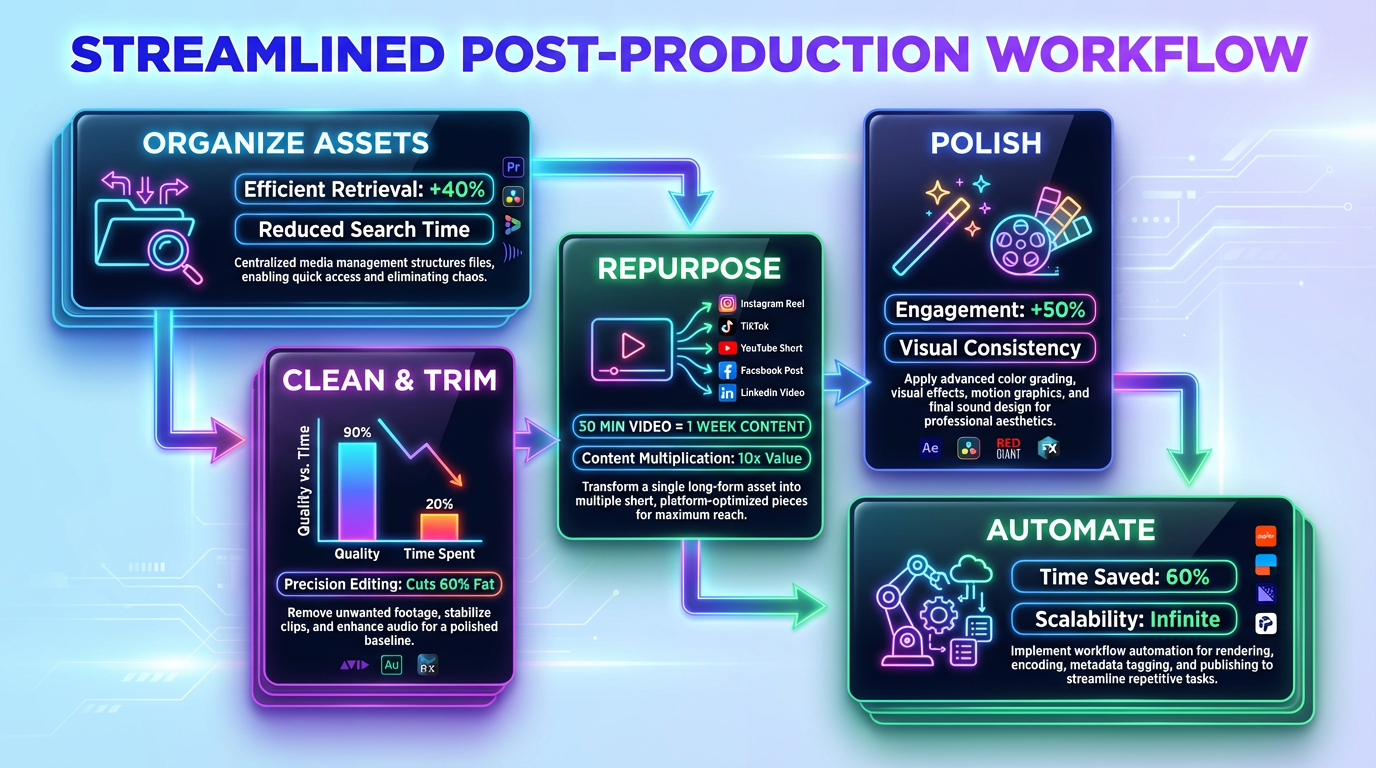
A single source asset can move from research and script development to generated footage, post-production, localization, and final delivery without an internal team stitching the process together manually. This allows brands to scale content output while maintaining speed, quality, and a consistent voice. Companies that outgrow a DIY stack can work with XTRND to connect research, generation, editing, and distribution into a single production system.
Practical Decision Framework
Software selection depends on what the final asset needs to accomplish. A TikTok reel demands a different pipeline than a cinematic brand film, and an identical treatment of both formats wastes budget on tools that fail to serve the format. An organized approach matches the tool stack to the content type from the start.
The following blueprint covers the four most common production scenarios and maps AI tools for content creation and AI editing tools to each:
-
Social media reels: InVideo AI generates platform-native drafts. Opus Clip extracts highlight segments from any existing long-form material. Canva Pro handles thumbnail and overlay graphics. This stack prioritizes speed and volume over cinematic quality.
-
Educational content: Descript anchors the workflow with transcript-based edits, automatic captions, and filler word removal. Canva Pro builds diagrams, slides, and support visuals. ChatGPT Plus drafts lesson outlines and structures module sequences. Clarity and pacing matter more than visual effects here.
-
Cinematic brand videos: Kling AI or Google Veo generates the base footage. Runway Gen-4.5's ALF feature refines motion and composition. Topaz upscales the final render to broadcast-grade resolution. Descript handles audio cleanup. This stack demands the highest per-asset investment but produces the strongest visual output.
-
Global campaigns: The full production stack feeds into HeyGen for lip-synced video translation across target languages. InVideo AI reformats localized assets into platform-specific variations. Opus Clip extracts region-specific highlight clips. One production session populates multiple channels across multiple markets.
Each scenario follows the same underlying sequence of research, generation, edits, and distribution. The tools change, but the pipeline logic stays constant through the final conclusion.
Conclusion
In summary, organizations that ship consistently avoid stalling because they connect their software into a repeatable pipeline. These organizations string their AI tools for content creation together so that research flows into generation, generation flows into editing, and editing flows into distribution. They often start with a basic subscription stack and expand stage by stage. As production demands grow beyond what manual stitching can sustain, they work with execution partners like XTRND to connect pre-production through delivery with engineered handoffs. Evaluating current workflows and linking applications today helps these organizations build a stronger production foundation.